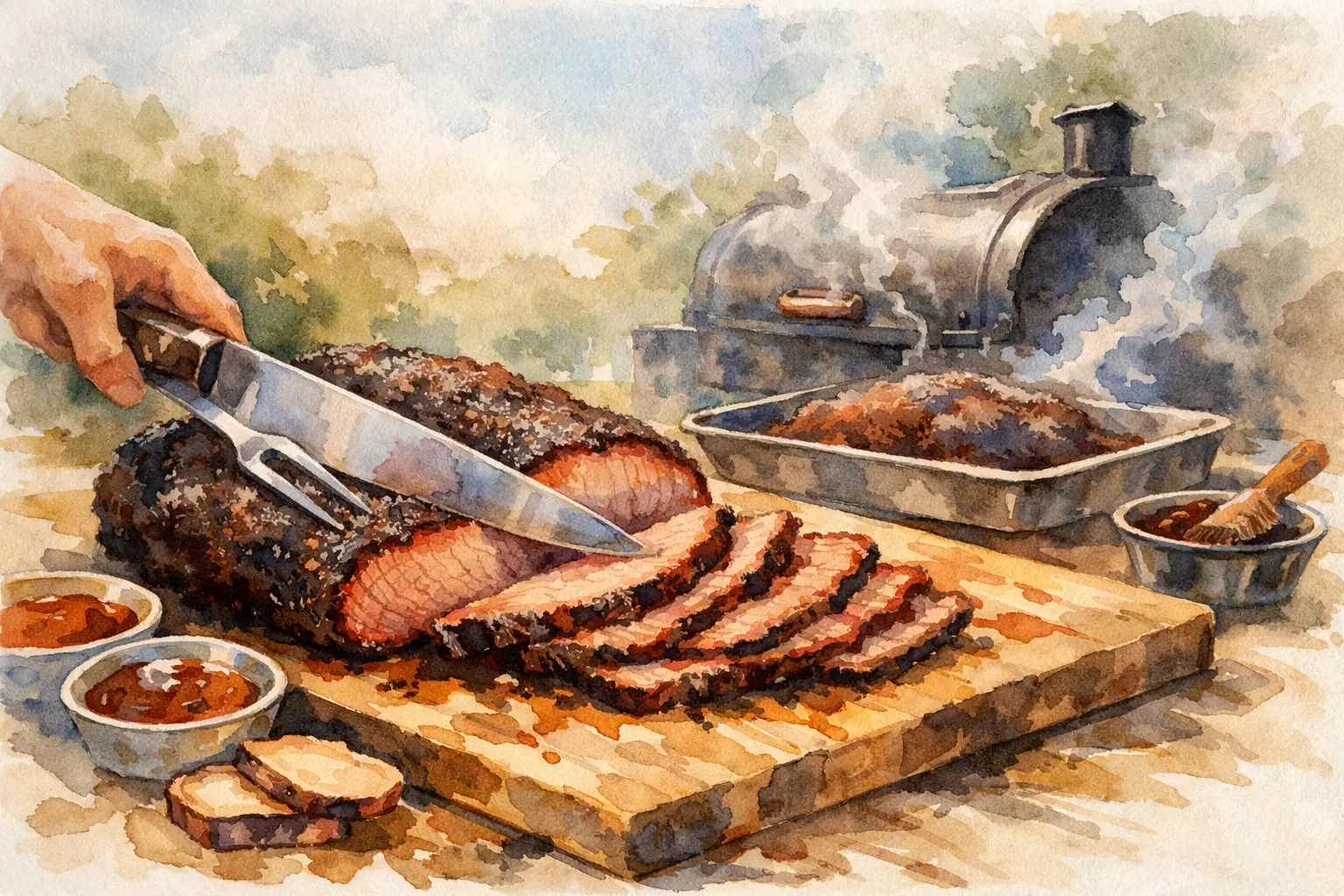
A great brisket does not come out of a smoker by accident. How smoked brisket is prepared comes down to patient heat, good beef, proper trimming and knowing when to leave it alone. The result should be dark and barky on the outside, tender through the middle and juicy enough that every slice earns its place in the box.
For a 12-hour American-style smoked brisket, there are no shortcuts worth taking. Fire and smoke can add plenty of flavour, but they cannot rescue rushed cooking, poor temperature control or a brisket sliced before it has rested.
How smoked brisket is prepared from the start
Brisket comes from the breast area of the animal, a hard-working cut with plenty of connective tissue. That is why it needs a long, gentle cook. Done fast, it can be firm, dry and chewy. Given time at low heat, its collagen gradually breaks down into gelatine, creating the soft, rich texture people chase in proper smoked BBQ.
A whole brisket has two main muscles: the flat and the point. The flat is leaner and gives clean, even slices. The point has more fat running through it, which makes it richer and more forgiving. Cooking them together lets the fat and connective tissue do their work over a long smoke.
The process starts with a quality whole brisket. Size matters because a larger cut handles a long cook better than a thin piece of beef. It also needs enough fat to protect the meat while it sits in the smoker for hours. Lean brisket can still taste good, but it leaves a much smaller margin for error.
Trim for flavour, not waste
Before seasoning, the brisket is trimmed. The aim is not to remove every bit of fat. Fat brings flavour and helps shield the meat, but thick, hard patches will not properly render during the cook. Those sections need to come off.
A thin, even fat cap is usually left behind. Rough edges are squared up so they do not burn, and loose pieces are removed. This gives the brisket a more even shape, which means more even cooking. It is practical work, not glamorous work, but it has a big say in the final slice.
A simple rub lets the beef speak
Smoked brisket does not need a cupboard full of seasonings. Salt and black pepper are the backbone of a traditional American-style rub. Garlic, onion, paprika or chilli can add another layer, depending on the house style, but the beef, smoke and bark should still lead.
The seasoning is applied generously across every surface. It sticks to the moisture on the outside of the brisket and becomes part of the bark as the cook progresses. That bark is the deeply savoury crust that gives smoked brisket its signature look and bite. It is not burnt, and it should not be hard as leather. Good bark has depth, texture and a little give beneath the knife.
Low heat, clean smoke and a long day
Once seasoned, the brisket goes into a smoker running at a steady low temperature, often around 110 to 135°C. The exact setting depends on the smoker, the weather, the brisket itself and the pitmaster's process. Consistency matters more than chasing one magic number.
The meat is cooked indirectly. It is not sitting directly over a flame like a steak on the barbie. Instead, heat circulates through the cooking chamber while hardwood smoke passes over the brisket. Clean smoke is crucial. It should smell pleasant and lightly woody, not thick, bitter or acrid. Dirty smoke can turn hours of careful work into a harsh, sooty feed.
During the first stage, the brisket builds colour and bark while the internal temperature steadily climbs. This is when the smoker does its visible work. The outside darkens, the seasoning firms up and the fat begins to render. Opening the lid every few minutes only slows the process, so experienced cooks check with purpose rather than fussing over the meat.
Some briskets are lightly spritzed during the cook to keep the surface from drying too quickly and to support bark development. Others are left alone. Both approaches can work. What matters is reading the brisket, not following a ritual for the sake of it.
The stall is normal
At a certain point, usually when the brisket reaches roughly 65 to 75°C internally, the temperature may stop rising for a while. This is called the stall. Moisture evaporating from the surface cools the meat, much like sweat cools skin. It can test anyone's patience, especially when hungry customers are waiting.
The brisket can be left unwrapped to push more smoke and bark, or wrapped in butcher's paper or foil to move through the stall faster. Unwrapped brisket often develops a firmer bark but can take longer and lose more moisture. Wrapping protects the cook and speeds things along, though foil can soften the bark. Butcher's paper sits somewhere in the middle, holding some moisture while allowing the exterior to breathe.
There is no one correct choice every time. The right call depends on the bark already formed, the cut's fat content, the smoker's behaviour and the service schedule. That judgement is where preparation turns into craft.
Tenderness decides when it is done
A thermometer is useful, but brisket is not finished just because it reaches a particular number. Most cooks begin checking closely somewhere around 90°C internal temperature. The real test is feel.
A temperature probe should slide into the flat and point with very little resistance, similar to pushing through soft butter. If one section still feels tight, it needs more time. Taking brisket off too early is one of the most common mistakes. The meat may look ready, but its connective tissue has not fully relaxed, and the slices will pull apart rather than yield cleanly.
The final internal temperature often lands in the low-to-mid 90s, but every brisket is different. One may feel perfect at 92°C, while another needs a little longer. This is why time and tenderness matter more than a rigid temperature target.
Resting is where the brisket settles
When the brisket comes off the smoker, the job is not over. Resting is essential. Fresh from the heat, the juices are still moving hard through the meat. Slice immediately and they run straight onto the board instead of staying in the brisket.
A proper rest lets the temperature ease down and the juices redistribute. Depending on the cook and service plan, brisket may rest for several hours in a warm holding environment. This improves tenderness, makes slicing cleaner and gives the flavour time to settle.
For a fast-casual kitchen, holding well is part of serving well. Brisket should be ready when the order lands, but it should never feel like it has been rushed just to meet the clock. At Brisket & Briyani, that long-cooked brisket is built to stand up beside freshly made Chennai-style briyani, where smoky beef, whole spices and fluffy basmati make a proper meal rather than a novelty combo.
Slicing makes or breaks the serve
The final step is simple to describe and easy to get wrong: slice against the grain. Cutting across the muscle fibres shortens them, making each bite more tender. Cutting with the grain leaves long fibres intact, so even a beautifully cooked brisket can eat chewy.
The flat is usually sliced into neat pieces, with enough thickness to stay juicy without becoming clumsy. The point may be sliced differently because its grain runs another way and its richer texture handles a heavier cut. A sharp knife matters. Sawing at brisket tears the bark and squeezes out moisture.
Good smoked brisket should not need to be drowned in sauce. Sauce can be great on the side, but the first bite should tell you whether the beef was trimmed properly, smoked with clean heat, cooked until tender and rested with patience. You should taste the peppery bark, rendered fat, deep beef flavour and gentle smoke before anything else takes over.
That is why brisket takes time. It is not just meat left in a smoker all day. It is a sequence of small calls made well, from the trim to the rest, so the final slice is worth showing up hungry for.
Ready to try it? We cook fresh every week.
Chennai-style briyani and 12-hour smoked brisket. Sunnybank, every Saturday from 5 PM.
See Our Full Menu →